
Kathryn Ko, MD, MFA
Introduction
In September of 2003, the body of an unidentified white male was found wrapped in
plastic garbage bags in an industrial section of the Bronx. The deceased was in an advanced
state of decomposition. The individual was 5′ 10″ and, based on anthropological analysis,
estimated to be between 40 and 60 years old. He was notably wearing a light-colored
“Brooks Brothers” shirt with a laundry tag labeled “Felix.” The police investigation of this
man’s death remains open. The New York City Medical Examiner’s evaluation has left the
cause and manner of death as undetermined, but the probability of homicide is low. Of
particular interest in this case is evidence of significant prior neurosurgical intervention. As all attempts to identify this individual through forensic methods have failed, the authors are presenting this case with the hope that members of the medical community may be able to provide information leading to his identification.
Background and Importance
Cranial plates and screws commonly are utilized to affix the bone flap to the calvarium
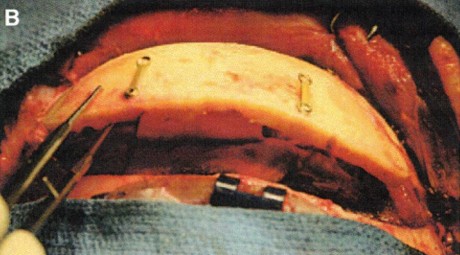
after craniotomy or trauma. Based on the configuration of the bone flap and accompanying plates and screws, it is possible to suggest what type of surgery a person has undergone and assist in ascertaining the medical history. Thus, metallic implants in this case and in general use throughout the body can be helpful in the identification of the unknown deceased (Figures 1,2a and 2b).
Clinical Presentation
Autopsy revealed that this the person underwent an antemorte bifrontal craniotomy, with evidence of rewiring of the right orbit inferiorly and laterally at the orbital-zygomatic process. There are plates and screws overlying the anterior wall of the frontal sinus. The frontal sinus has a 1-by-2.5-cm area of erosion on the posterior wall toward the right. The anterior fossa is intact, as is the crista galli. The nasal septum is asymmetrical, possibly a result of trauma. The orbital floor on the right is compromised with an area of missing bone. There is evidence of bone growth and remodeling of the burr holes. In one of the dural tacking holes, a remnant of the non-dissolving suture can be found.
The plates and screws have been identified as manufactured by Medtronic (Minneapolis) and appear to have self-drilling tips, possibly originating in the mid- to late-1990s. A survey of New York City hospitals using Medtronic implants of this type did not yield further information on this person. Some screws are blue-colored – presumably “rescue” screws with slightly larger diameters than the silver screws. The full frontal view of the cranium is depicted in Figure 1 (painting by the author, acrylic on canvas).

Oblique frontal photographs are shown in Figures 2a and 2b.

A CT scan did not yield additional information.
Conclusion
This unknown male underwent extensive cranial surgery that predated his death. Due to
the scrupulous nature of medical record-keeping and the comparative infrequency of this
type of operation, we are confident that someone with access to this review may have
information leading to the identification of this man. It is evident that this person received
the highest level of care from his neurosurgical team. It is hoped that this same
neurosurgeon may once again intervene on his behalf to bring this cold case to final
resolution. Individuals with information pertaining to this matter are urged to contact the
author.
 Neurosurgery Le Freak - Kathryn Ko, MD, MFA
Leave a comment